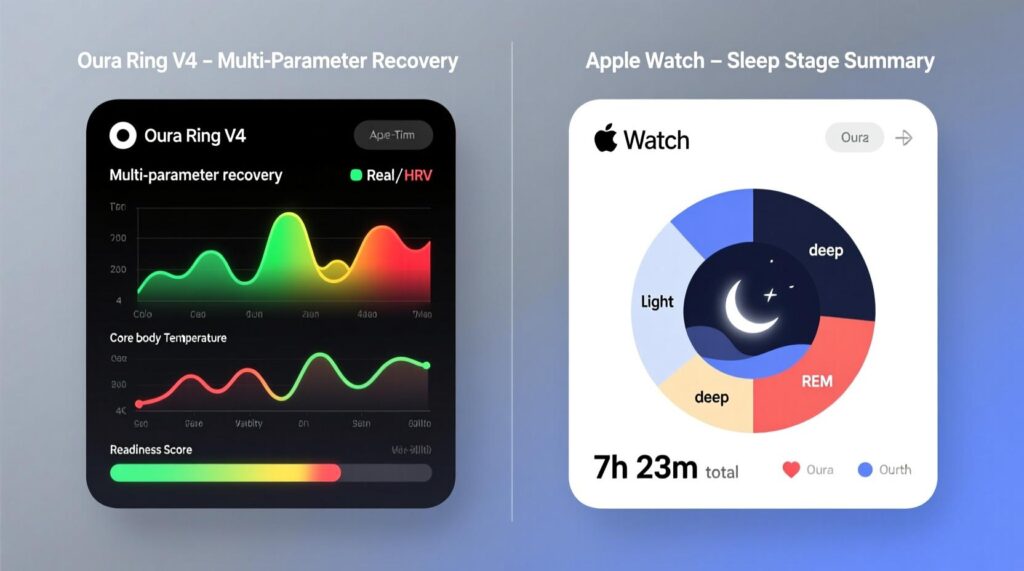

Choosing a wearable for sleep tracking is harder than comparing step counts or screen quality. The real question is whether a device can reliably estimate when a person is asleep, awake, or moving between REM, light, and deep sleep.
The debate around Oura Ring vs Apple Watch sleep tracking accuracy is particularly interesting because the two products approach sleep monitoring differently. The Oura Ring Gen 4 is designed primarily as a health and recovery wearable, while the Apple Watch Series 10 is a full smartwatch that happens to provide increasingly sophisticated sleep data.
Both can estimate sleep duration and sleep stages. Both collect heart-rate and movement information overnight. Both can provide useful trends over time. But neither is equivalent to a clinical sleep study.
So, which one is better?
Oura Ring vs Apple Watch Sleep Tracking Accuracy at a Glance
Before looking at individual sleep stages, it helps to understand what each device is actually measuring.
| Category | Oura Ring Gen 4 | Apple Watch Series 10 |
|---|---|---|
| Sleep duration | Excellent for consumer wearable | Very good |
| Sleep/wake detection | Strong | Strong |
| REM estimation | Generally strong, but not PSG-equivalent | Good, with study-dependent variation |
| Deep sleep estimation | Useful for trends | Useful for trends |
| Light/Core sleep | Useful but imperfect | Useful but imperfect |
| HRV | Yes | Yes |
| Respiratory metrics | Yes | Yes |
| Temperature sensing | Yes | Yes |
| Sleep score | Oura Sleep Score | Apple Health provides sleep data rather than an identical proprietary score |
| Battery | Typically 5–8 days | Up to 18 hours normal use |
| Sleep-apnea feature | Health insights vary by feature and region | Sleep-apnea notifications on supported models/regions |
| Subscription | $5.99/month or $69.99/year in the U.S. | No Apple Watch sleep-data subscription |
| Best for | Sleep/recovery-focused users | Users wanting a smartwatch + health tracker |
Oura says the Ring 4 typically lasts 5–8 days, depending on size, settings, usage and other factors. Apple rates the Series 10 for up to 18 hours of normal use, with eight minutes of charging providing up to eight hours of sleep tracking.
How Accurate Is Sleep Tracking Compared With PSG?
The most important point in the Oura Ring vs Apple Watch sleep tracking accuracy discussion is that consumer wearables do not directly measure sleep stages in the same way as PSG.
During clinical polysomnography, technicians use EEG signals to identify characteristic brain-wave patterns. REM sleep is also evaluated using eye movements and muscle activity. Consumer wearables generally infer sleep stages from combinations of movement, heart rate, heart-rate variability, respiratory patterns and other signals.
This is an estimation problem rather than direct measurement.
A 2024 study published in Sensors compared Oura Ring Gen 3, Fitbit Sense 2 and Apple Watch Series 8 with PSG in 35 healthy adults. All three devices had at least 95% sensitivity for identifying sleep versus wake. For individual sleep stages, however, sensitivity varied considerably.
What the Research Says About Oura
One particularly useful validation study examined the Oura Ring Gen 3 with its Sleep Staging Algorithm 2.0 against multi-night ambulatory PSG in 96 participants, producing more than 421,000 scored epochs.
The study reported overall sleep/wake accuracy around 91.7–91.8%, with sleep-stage accuracy ranging from 75.5% for light sleep to 90.6% for REM sleep. The investigators concluded that the device showed good agreement with PSG for several global sleep measures and for light and deep sleep duration.
Those results provide meaningful evidence supporting Oura’s sleep-tracking approach, although they still do not make the ring a clinical PSG replacement.
What the Research Says About Apple Watch
Apple Watch research also shows that the technology can provide useful sleep-stage estimates, but accuracy depends heavily on the specific algorithm, generation and test population.
A recent study using Apple Watch data and EEG-based reference labels reported 71% four-class sleep-staging accuracy for wake, light, deep and REM sleep in a research framework. The authors emphasized PSG/EEG as the reference standard.
REM, Deep and Light Sleep: Which Device Wins?
The most visible part of the Oura Ring vs Apple Watch sleep tracking accuracy debate is usually the sleep-stage chart.
Users often wake up and immediately check how many minutes of REM or deep sleep they received. That number can look extremely precise. A graph might say 1 hour 23 minutes of REM sleep, for example, but that does not mean the device actually measured REM sleep for exactly 83 minutes.
Sensors: Why Finger Placement May Matter
A major factor in the Oura Ring vs Apple Watch sleep tracking accuracy comparison is sensor location.
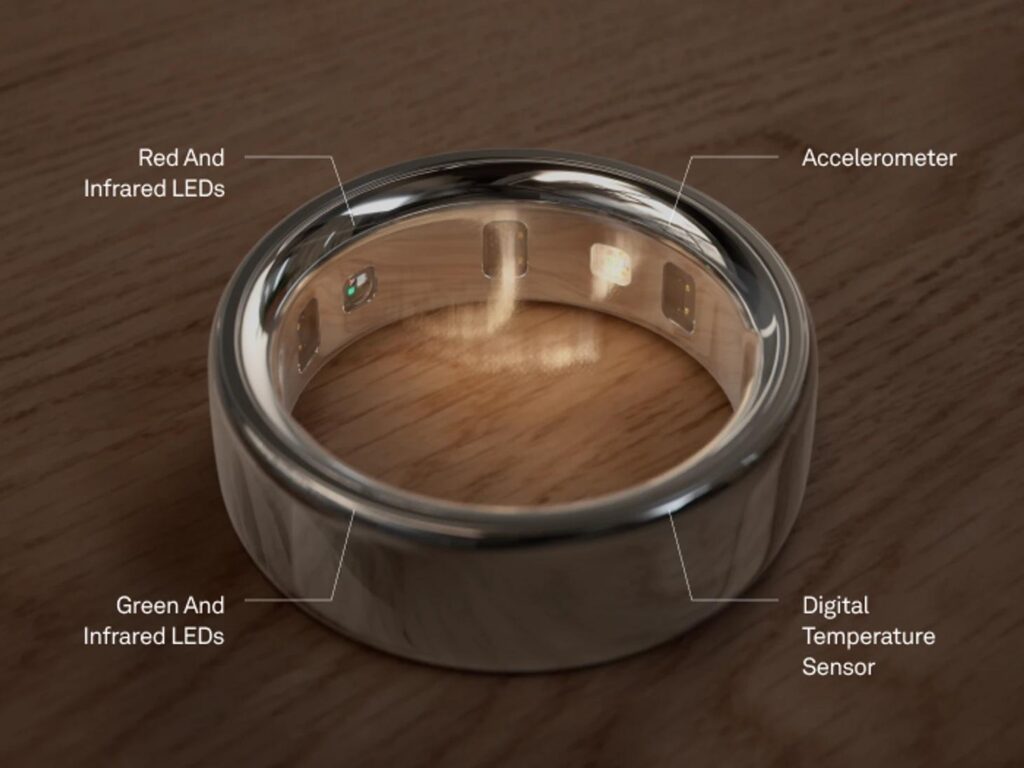
The Oura Ring Gen 4 sits on the finger, where it uses multiple sensing technologies. Oura lists red and infrared LEDs for blood oxygen measurements, green and infrared PPG sensors for heart rate and HRV, a digital temperature sensor, and an accelerometer for movement. Its Smart Sensing system dynamically selects signal pathways.
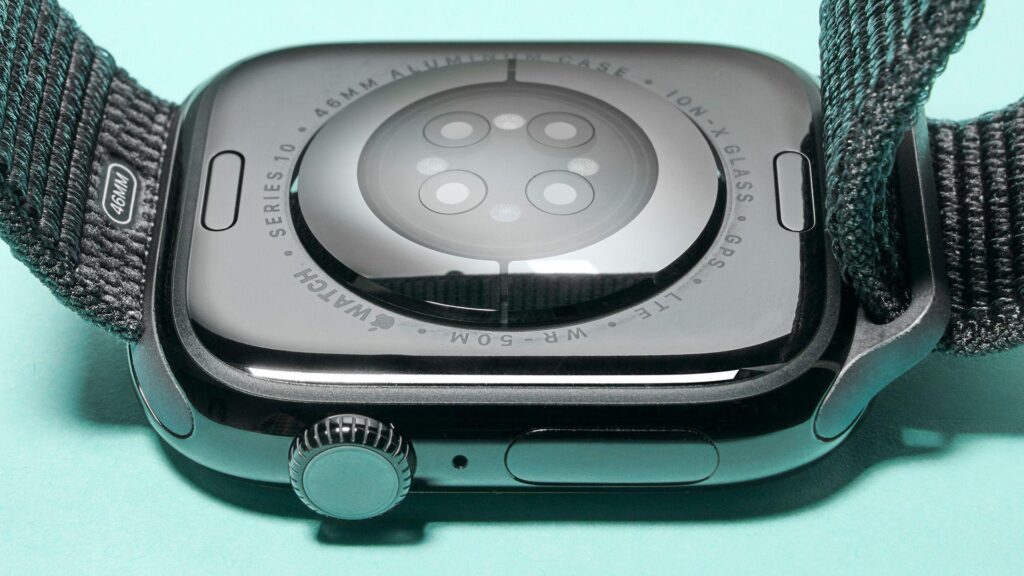
The Apple Watch Series 10 uses a third-generation optical heart sensor, electrical heart sensor, temperature sensor, high-g accelerometer and gyroscope, among other hardware.
Neither approach is inherently perfect.
The finger can provide strong optical signals, but rings can move or rotate. Apple Watch benefits from a mature wrist-based sensing platform but depends on proper fit and continuous wear.
Apple specifically advises users to wear the watch comfortably and notes that a loose fit can allow excessive movement to affect measurements.
HRV and the Sleep Score Algorithm
The value of a sleep wearable is not limited to sleep stages.
Heart-rate variability (HRV) is another important overnight metric. Both devices can collect heart-related information, but the way the data is presented differs.
Oura is particularly focused on combining sleep, resting heart rate, HRV, temperature and activity into a broader recovery picture. Its Sleep Score algorithm turns multiple measurements into a simplified score intended to help users understand their sleep patterns.
Apple takes a more ecosystem-oriented approach. Sleep information can be viewed through Apple Health, alongside heart rate, respiratory rate and, on compatible models, wrist-temperature information.
Battery Life Can Change Accuracy in the Real World
Battery life is an underrated part of the Oura Ring vs Apple Watch sleep tracking accuracy question.
A theoretically excellent sleep tracker is not useful if the user repeatedly removes it overnight to charge.
Oura Ring 4 is rated for 5–8 days of typical battery life.
Apple Watch Series 10 is rated for up to 18 hours of normal use and up to 36 hours in Low Power Mode. Apple also states that eight minutes of charging can provide up to eight hours of sleep tracking.
This means Apple has designed around a different charging model.
A user can charge the Series 10 shortly before bed, after waking, or during another short window. But users who forget to charge it can lose an entire night’s sleep record.
Oura’s longer battery window makes continuous overnight wear considerably easier.
For sleep-only consistency, Oura has the obvious battery advantage.
Cost: Oura Subscription vs Apple Watch
The financial side of the Oura Ring vs Apple Watch sleep tracking accuracy comparison is straightforward but important.
Oura requires a membership for its full experience. In the United States, Oura currently lists membership at $5.99 per month or $69.99 per year. New members receive one included month.
Apple does not charge a separate monthly fee to access the Apple Watch’s standard sleep tracking features.
That makes the long-term ownership equation different.
With Oura, the buyer pays for both hardware and an ongoing service. In exchange, the app emphasizes detailed health trends, readiness and sleep interpretation.
With Apple Watch, the buyer pays for the hardware but does not need an equivalent recurring subscription for basic sleep data.
For budget-conscious users who already own an iPhone, Apple therefore has an important advantage.
Sleep Apnea: A Different Kind of Sleep Tracking
Sleep-stage accuracy is not the only health feature worth considering.
Apple Watch Series 10 supports sleep-apnea notifications in supported regions and configurations. Apple says the feature uses accelerometer-based breathing-disturbance measurements and looks for patterns over multiple nights.
Importantly, Apple states that the Apple Watch is not a medical device and that the feature does not replace professional diagnosis.
That distinction matters.
A consumer wearable can potentially identify a pattern worth discussing with a healthcare professional. It cannot replace a clinical evaluation or diagnostic sleep study.
This is another reason not to interpret a sleep score or sleep-stage chart as a medical diagnosis.
Conclusion
Ultimately, choosing between the Oura Ring Gen 4 and the Apple Watch Series 10 comes down to prioritizing either dedicated recovery tracking or multi-purpose smartwatch functionality.
The Oura Ring Gen 4 stands out as the superior choice for sleep-first monitoring.Its screenless, lightweight ring form factor fits unobtrusively overnight, while its multi-path optical sensors capitalize on strong finger-artery signals to capture accurate deep and REM sleep stages.Paired with a multi-day battery life and holistic readiness insights, it provides an exceptional, friction-free ecosystem for tracking biological recovery—provided you are willing to pay the monthly subscription fee.
Conversely, the Apple Watch Series 10 excels as a comprehensive health and lifestyle device. While its daily charging requirement and wrist form factor demand more routine management overnight, it matches the Oura in total sleep accuracy, adds FDA-cleared Sleep Apnea notifications, and charges no ongoing subscription fees.
If your primary goal is optimizing circadian rhythms and daily energy with zero screen distractions, choose Oura. If you want a zero-subscription smartwatch that balances solid nocturnal metrics with robust daytime fitness and connectivity, the Apple Watch Series 10 remains the better overall value.